Current Issue · Volume 1 No. 1

NLCS Jeju SNHS Journal of Scientific Research

Volume 1 introduces four student-led papers spanning oncologic diagnostics, CRISPR-Cas9, brain organoids, and recycled aggregate recovery.

NLCS Jeju SNHS 34 pages May 2026
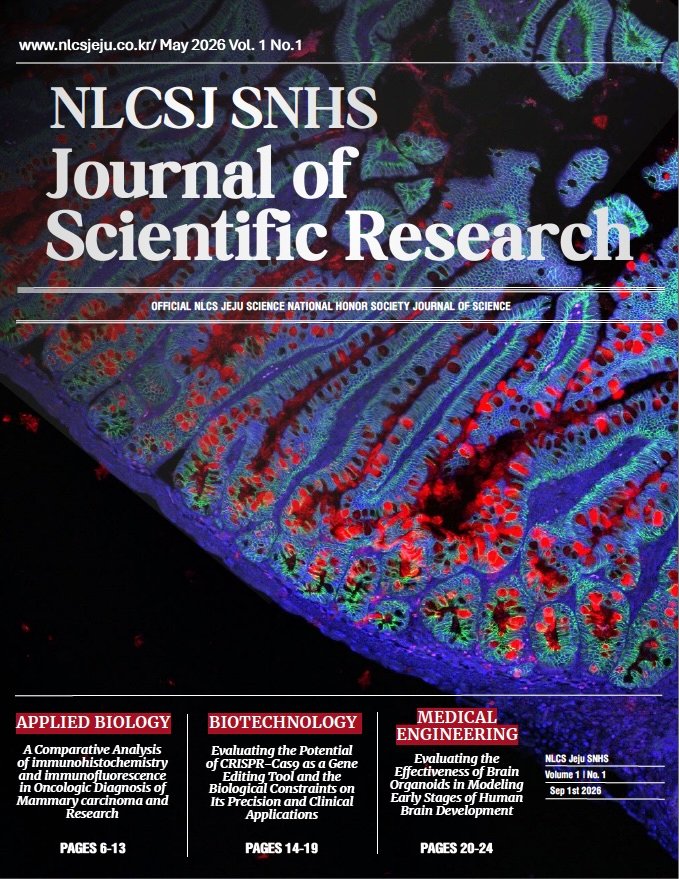
NLCS Jeju SNHS Journal of Scientific Research cover Volume 1 · Issue 1
Volume 1 · Issue 1 Student-led research Open access publication 4 featured papers

Read the current publication

Each new journal becomes the current issue. When a new PDF is published, the previous issue moves automatically into the archive below.

NLCS Jeju SNHS Journal of Scientific Research cover — click to read
Current issue

NLCS Jeju SNHS Journal of Scientific Research

Volume 1 introduces four student-led papers spanning oncologic diagnostics, CRISPR-Cas9, brain organoids, and recycled aggregate recovery.

Volume 1 · No. 1Issue
May 2026Published
34 pagesLength
  • A Comparative Analysis of Immunohistochemistry and Immunofluorescence in Oncologic Diagnosis of Mammary Carcinoma
  • Evaluating the Potential of CRISPR-Cas9 as a Gene Editing Tool and the Biological Constraints on Its Precision and Clinical Applications
  • Evaluating the Effectiveness of Brain Organoids in Modeling Early Stages of Human Brain Development
  • Experimental Analysis of Recycled Aggregate Recovery from Waste Concrete Using Chemical Corrosion Processing

Previous issues

Earlier journals will appear here automatically.

This is the first issue. The archive will begin when the next journal is published.

Current Research Highlights

Read investigations, reviews, and scientific perspectives produced by members of the NLCS Jeju Science National Honor Society.

From classroom theory to cutting-edge research

The inaugural volume bridges classroom knowledge and real-world scientific inquiry. From gene editing precision to sustainable construction, each paper demonstrates how students can synthesise prior learning into original investigation.

Diagnostic techniques are compared with clinical rigour, weighing sensitivity against practical constraints.
Gene editing constraints are examined beyond theoretical promise — addressing off-target effects and delivery barriers.
Brain organoids are evaluated as developmental models, questioning how faithfully they replicate neural processes.
Waste concrete is reimagined as a resource through chemical processing methods with measurable outcomes.
Why it matters

Student research that connects textbook science to real applications builds the confidence and skills needed to contribute meaningfully to scientific discourse beyond the classroom.

Read the featured papers
A clear research pathway
1

Ask a focused question

Define a specific, measurable problem rooted in careful observation.

2

Design the method

Select variables, controls, sample sites, and an ethical collection plan.

3

Gather evidence

Record field and laboratory data consistently and transparently.

4

Interpret the pattern

Connect results to the question without overstating the evidence.

5

Share and refine

Write clearly, invite feedback, and make the work useful to others.

34pages published
4original papers
4student authors
100%student-led

Curiosity, rigour, and scientific community

SNHS gives students a place to pursue meaningful questions, communicate evidence clearly, and learn from peers working across scientific disciplines.

01

Begin with curiosity

Members turn observations from Jeju, the classroom, and the wider world into questions worth investigating.

02

Work with rigour

Methods, evidence, sources, and limitations are treated with the care strong scientific communication requires.

03

Share generously

Research becomes more useful when it is explained clearly, discussed openly, and made available to the community.

Journal publishing

A growing archive of
student scientific research

Each issue preserves original investigations, reviews, and scientific perspectives from the NLCS Jeju science community.

Evidence-based writingClear referencingStudent authorshipOpen scientific discussion

Get in touch

Have a question about the journal or want to contribute? Send us a message and we will get back to you.